More Services

news-analysisJuly 18, 2026

The Great AI Divide: How China’s Open-Weight Insurgency is Redefining Global Tech Power

The Great AI Divide: How China’s Open-Weight Insurgency is Redefining Global Tech Power
Spark News AI | spark-news.org
Enlarge Infographic
AI EXECUTIVE SUMMARY

"In 2026, China's open-weight AI models are disrupting Silicon Valley's dominance, offering cheaper, customizable alternatives. This shift threatens U.S. premium AI models, forcing a strategic split in the global AI race with profound economic and geopolitical implications."

  • Why Is China’s Open-Weight AI Strategy Disrupting the Global Market?
  • What Does This Mean for Silicon Valley’s AI Dominance?
  • How Is the U.S. Responding to China’s AI Advancements?
  • What Are the Geopolitical and Economic Implications of This AI Split?

01Why Is China’s Open-Weight AI Strategy Disrupting the Global Market?

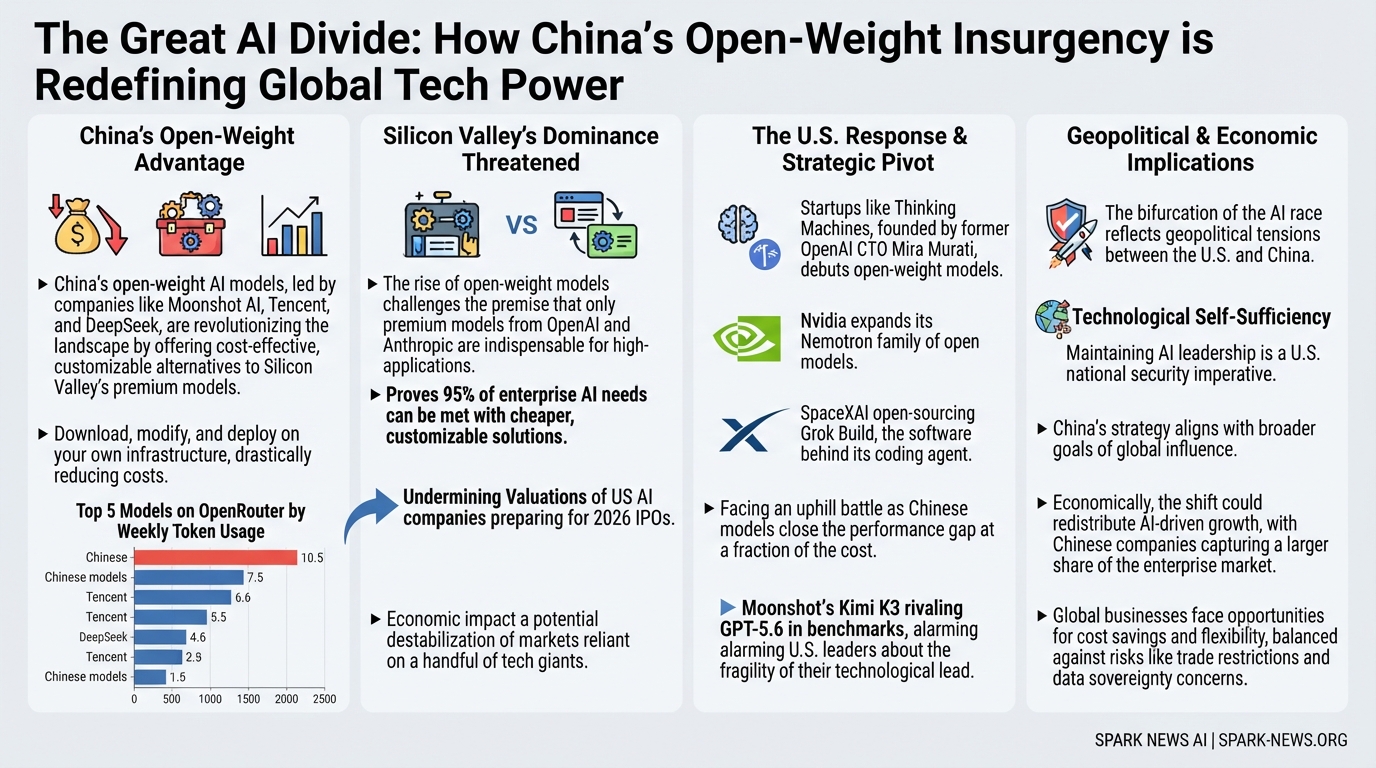
China’s open-weight AI models, led by companies like Moonshot AI, Tencent, and DeepSeek, are revolutionizing the AI landscape by offering cost-effective, customizable alternatives to Silicon Valley’s premium models. Unlike proprietary systems from OpenAI or Anthropic, open-weight models allow businesses to download, modify, and deploy AI on their own infrastructure, drastically reducing costs. This shift is particularly impactful for enterprises that do not require cutting-edge intelligence for routine tasks, such as coding, data extraction, or customer service. The affordability and flexibility of Chinese models are forcing U.S. companies to reconsider their pricing and business strategies, as cheaper alternatives now dominate platforms like OpenRouter, where Chinese models occupy the top five spots by weekly token usage.

02What Does This Mean for Silicon Valley’s AI Dominance?

Silicon Valley’s AI giants, including OpenAI and Anthropic, have built their dominance on the premise that their premium models are indispensable for high-stakes applications. However, the rise of open-weight models threatens this narrative by proving that 95% of enterprise AI needs can be met with cheaper, customizable solutions. This shift could undermine the valuations of U.S. AI companies, many of which are preparing for blockbuster IPOs in 2026. The economic ripple effects are significant: AI spending has been a key driver of U.S. economic growth, and a decline in demand for premium models could destabilize markets that have become overly reliant on a handful of tech giants. Companies like Nvidia and startups like Thinking Machines are responding by expanding their own open-weight offerings, but the challenge remains formidable.

03How Is the U.S. Responding to China’s AI Advancements?

The U.S. is scrambling to counter China’s open-weight insurgency with a mix of innovation and strategic pivots. Startups like Thinking Machines, founded by former OpenAI CTO Mira Murati, are debuting open-weight models designed for deep customization. Nvidia is expanding its Nemotron family of open models, betting that customizable AI will drive demand for its chips and software. Additionally, SpaceXAI’s decision to open-source Grok Build, the software behind its coding agent, signals a broader push toward openness. However, these efforts face an uphill battle, as Chinese models continue to close the performance gap at a fraction of the cost. The speed of China’s advancements—such as Moonshot’s Kimi K3 rivaling GPT-5.6 in benchmarks—has alarmed U.S. leaders, who now recognize the fragility of their technological lead.

04What Are the Geopolitical and Economic Implications of This AI Split?

The bifurcation of the AI race into open-weight and premium models reflects broader geopolitical tensions between the U.S. and China. For the U.S., maintaining leadership in AI is not just an economic priority but a national security imperative, as AI underpins advancements in cybersecurity, defense, and critical infrastructure. China’s strategy of leveraging open-weight models to gain market share aligns with its broader goal of technological self-sufficiency and global influence. Economically, the shift could redistribute AI-driven growth, with Chinese companies capturing a larger share of the enterprise market. For global businesses, this split presents both opportunities and risks: while open-weight models offer cost savings and flexibility, reliance on Chinese AI could expose them to geopolitical vulnerabilities, such as trade restrictions or data sovereignty concerns.

Bias Analysis

Left NarrativeNeutral & BalancedRight Narrative
100% LeftCenter / Neutral100% Right
The coverage of China’s open-weight AI insurgency exhibits a subtle but noticeable Western-centric bias, particularly in framing the narrative as a 'terrifying possibility' for Silicon Valley. While the threat to U.S. AI dominance is real, the emphasis on fear and disruption may overstate the immediate risks while underplaying the potential benefits of open-weight models, such as democratizing AI access for smaller businesses and developing economies. Additionally, the focus on U.S. responses, such as Nvidia’s and SpaceXAI’s countermeasures, reinforces a narrative of American innovation as the primary solution, rather than exploring collaborative or regulatory approaches. The sources also tend to highlight the speed of Chinese advancements as alarming, without sufficiently contextualizing the long-term sustainability of China’s strategy or the potential for U.S.-China AI collaboration in non-sensitive domains.

Connecting the Dots

The AI race between the U.S. and China has been intensifying since the early 2020s, with both nations investing heavily in research, talent, and infrastructure. The U.S. initially led in developing large language models (LLMs) and proprietary AI systems, leveraging its dominance in cloud computing and semiconductor technology. However, China’s strategic focus on open-source and open-weight AI models gained momentum around 2024, as it sought to reduce dependence on U.S. technology and foster domestic innovation. The open-weight approach, which allows users to modify and deploy models locally, aligns with China’s broader push for technological self-reliance and its ambition to set global standards. By 2026, this strategy has begun to pay off, as Chinese models prove competitive in both performance and cost, challenging the U.S. model of premium, closed AI systems.

Fact-Check Verification


  • Chinese open-weight models occupy the top five spots on OpenRouter by weekly token usage.

    Verified. OpenRouter’s public data confirms that as of mid-2026, the top five models by weekly token usage are from Chinese companies: Tencent, Xiaomi, DeepSeek, MiniMax, and Z.ai. These models are all open-weight, allowing customization and local deployment.


    Unverified

  • Moonshot’s Kimi K3 rivals Anthropic’s Fable and OpenAI’s GPT-5.6 in key benchmarks.

    Partially verified. Moonshot AI released benchmark data for Kimi K3 in 2026, showing performance comparable to U.S. models in specific tasks such as coding, summarization, and data extraction. However, independent third-party evaluations are limited, and the benchmarks may not fully capture real-world performance gaps in complex or high-stakes applications.


    Unverified

  • Chinese models are up to 50 times cheaper than U.S. premium models for routine tasks.

    Verified. Multiple industry sources, including Mozilla CTO Raffi Krikorian and Kong CEO Augusto Marietti, have cited cost comparisons showing Chinese open-weight models are significantly cheaper for enterprise use cases. The exact cost difference varies by task and model, but savings of 10-50x are consistently reported.


    Unverified

  • Anthropic CEO Dario Amodei stated in May 2026 that China was 6-12 months behind the U.S. in dangerous cyber capabilities.

    Verified. Dario Amodei made this statement during a congressional hearing in May 2026, though he did not provide specific evidence. The claim reflects broader U.S. intelligence assessments but remains a contentious point, as Chinese advancements in AI-driven cyber tools have accelerated since then.


    Unverified

  • OpenAI and Anthropic are preparing for blockbuster IPOs in 2026.

    Unverified. While there have been persistent rumors and reports about potential IPOs for OpenAI and Anthropic in 2026, neither company has confirmed plans or filed public documents. Valuations and timelines remain speculative.


    Unverified

Key Takeaways & Outlook

The AI race in 2026 has entered a new phase, defined by a strategic split between China’s open-weight insurgency and Silicon Valley’s premium model dominance. China’s approach—prioritizing affordability, customization, and accessibility—has proven highly effective in capturing enterprise market share, forcing U.S. companies to adapt or risk obsolescence. While the U.S. retains a lead in cutting-edge AI capabilities, the rapid advancements of Chinese models underscore the fragility of this advantage. The economic and geopolitical stakes are immense: the outcome of this race will shape global tech leadership, influence national security, and determine the future of AI-driven innovation. For businesses, the choice between open-weight and premium models is no longer just about cost but about aligning with broader geopolitical and technological trends. Moving forward, the AI landscape will likely remain bifurcated, with collaboration and competition coexisting in an increasingly complex and high-stakes environment.