
Why America's Largest School Districts Are Pulling the Plug on AI
Get weekly AI news audits & executive briefs directly in your LinkedIn inbox with 353+ tech leaders.
"As New York City and Los Angeles impose major AI bans in classrooms, parents and educators confront tough questions about childhood development, academic integrity, and the real value of educational technology."
- The Core Dilemma: Reclaiming the Human Foundation
- Core Pillars & Realities
- The Strategic & Practical Mandate
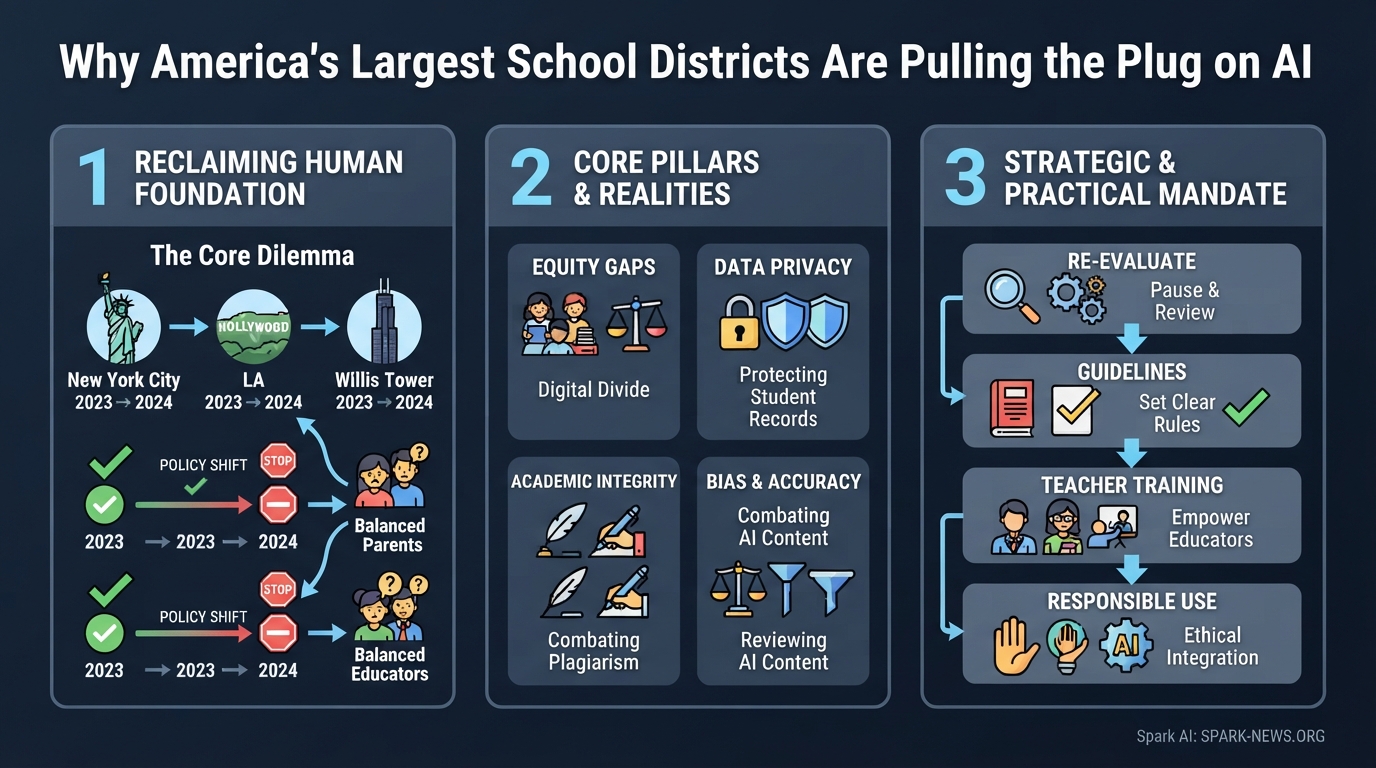
01The Core Dilemma: Reclaiming the Human Foundation
From a systems perspective, this abrupt reversal represents an immune response. When any powerful tool enters an environment before healthy boundaries and clear objectives are established, instability follows. Parents and teachers are not necessarily opposed to modern engineering. Rather, they are reacting to an unregulated experiment unfolding on young minds during critical stages of developmental growth. When basic literacy and independent problem-solving are still taking shape, introducing automated answers creates systemic vulnerabilities that no software patch can easily fix.
02Core Pillars & Realities
* Growing Skepticism Among Families and Teachers: Grassroots concern is surging. Nicki Petrossi, co-founder of the Tech-Safe Learning Coalition, notes that many parents feel their children have become an untested test group. This sentiment is reinforced by classroom data. A recent NPR/Ipsos poll revealed that 55 percent of teachers view generative tools primarily as an easy shortcut for students looking to skip honest academic work rather than an instrument of deeper understanding.
* The Friction of Built-In Technology: Declaring a ban is simple, but enforcing it is remarkably complicated. Modern classroom hardware comes pre-loaded with assistive capabilities. Google's Gemini, for instance, frequently appears directly within standard search workflows on student Chromebooks. School administrators face an infrastructure mismatch where consumer hardware undermines district policy.
* The Risk of Indiscriminate Restrictions: Blanket prohibitions carry collateral damage. Janice Jackson, former CEO of Chicago Public Schools and executive director of the Aspen Institute Education & Society Program, points out that thoughtful technology can augment instruction for English language learners and students with special needs. Cutting off access entirely risks removing helpful scaffolding for the young people who need personalized assistance the most.
03The Strategic & Practical Mandate
First, school districts need age-differentiated boundaries rather than uniform decrees. Young learners in primary grades require tactile, conversational, and direct human engagement to develop cognitive resilience and attention spans. Generative interfaces should remain completely outside early childhood environments. High schools, by contrast, should treat these tools like advanced calculators, teaching explicit verification, logic, and ethical limits within specific courses.
Second, education departments must demand better enterprise controls from tech providers. Districts should not be forced into an all-or-nothing corner simply because search engines bundle conversational bots into everyday operating systems. Procurement teams need software configurations that allow school administrators to disable generative prompts on student profiles without disabling access to research libraries.
Finally, assessment design must evolve back toward observable human reasoning. When 55 percent of educators see automated cheating taking hold, the assignment structure itself must change. Oral examinations, classroom debates, handwritten synthesis, and iterative project defenses restore integrity to the learning process while ensuring that cognitive effort stays where it belongs: inside the student's mind.
How do you assess the strategic impact of this development on enterprise architecture?

Dr. Hesham Mansour
Assistant Professor • Enterprise Solution Architect • CEO, iCare Solutions
Dr. Hesham Mansour steers the analytical and editorial direction of Spark News, backed by 30+ years of software leadership, 25+ years of academic excellence, and deep specialization in Model-Driven Development (MDD) and AI news intelligence.
Personalize Your News: Add Spark News as a Preferred Source
Get direct AI news audits, media bias analysis, and weekly architectural briefs featured in your Google Discover Feed, Top Stories, and AI Overviews with an official Preferred badge.
Add to Preferred Sources on Google→