
A Costly Summer Sendoff: Rethinking College Degree ROI and Debt
Featured in the weekly "Spark News: AI Media Brief" newsletter series on LinkedIn.
"Evaluating how college majors balance student debt, early career earnings, and rising unemployment rates to help students make sound financial and educational choices."
- The Core Dilemma: Weighing Debt Against Career Realities
- Core Pillars & Realities
- The Strategic & Practical Mandate
01The Core Dilemma: Weighing Debt Against Career Realities
The broader labor market is compounding this calculation. Unemployment among recent college graduates climbed from 4.4 percent in January 2024 to 5.6 percent by March 2026. Entry-level hiring faces headwinds from artificial intelligence adoption and employer reluctance to onboard recent graduates into remote positions. Choosing a field of study requires looking past traditional assumptions to evaluate both debt burdens and initial hiring realities.
02Core Pillars & Realities
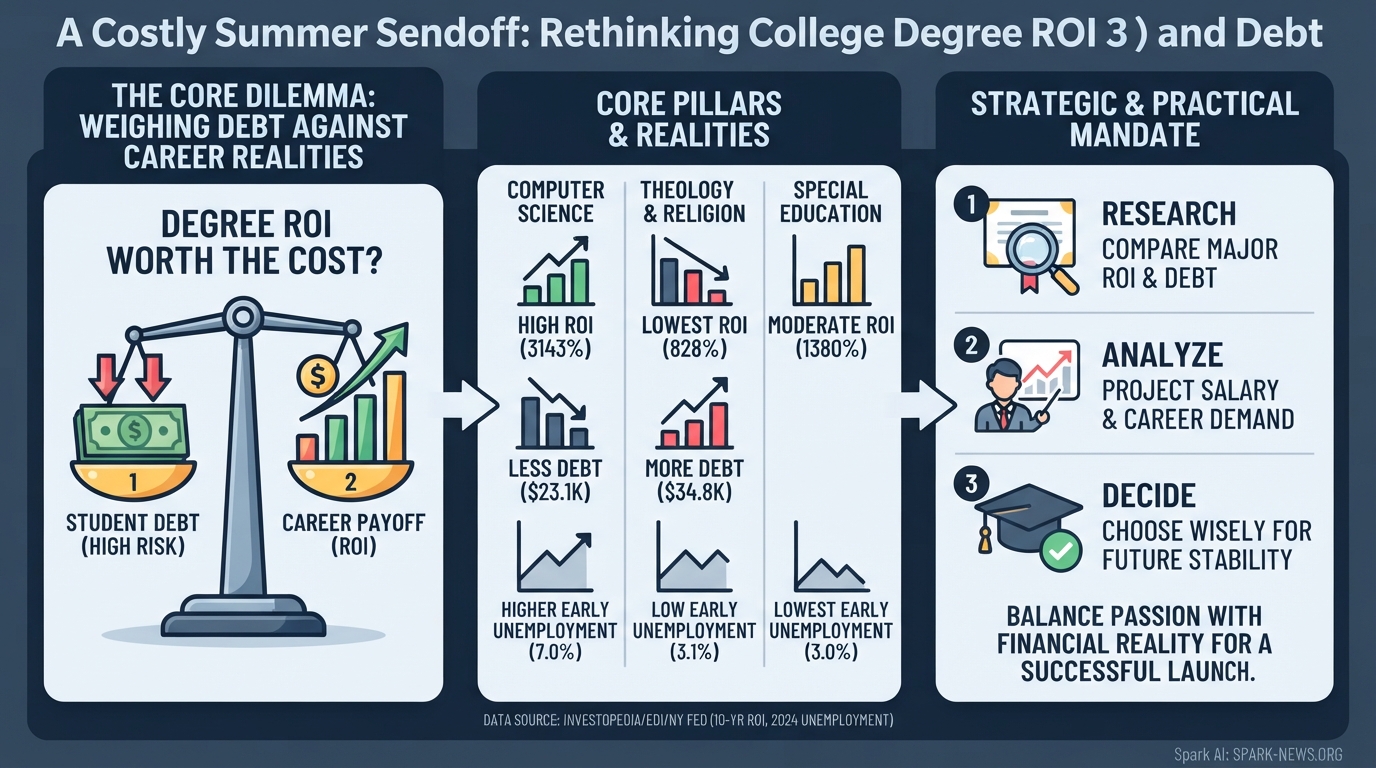
- The Baseline Financial Picture: Across all analyzed majors, the median student loan debt exceeds $24,700, while the median early career salary stands at $52,000. Every major analyzed generates a positive return on investment over ten years, and median degree holders consistently outearn peers without a bachelor degree.
- The High Return Contrast: Computer science majors secured the top return on investment at approximately 3,143 percent. These graduates borrowed about $1,600 less than the median student and earned nearly $35,000 more annually in their early careers. However, high earnings do not guarantee instant employment; computer science graduates saw a 7.0 percent unemployment rate in 2024, well above the overall graduate average.
- Job Stability Versus Earning Power: Fields with lower financial returns often deliver greater immediate job security. Theology and religion majors recorded the lowest ten-year return on investment at 828 percent, carrying higher average debt of roughly $34,800 and earning about $41,600. Yet their unemployment rate was just 3.1 percent. Similarly, special education majors posted the lowest unemployment rate across fields, despite generating the ninth-lowest return on investment at 1,380 percent.
- Vulnerability in the Humanities: Anthropology majors experienced the highest unemployment rate at 7.9 percent, alongside an investment return of roughly 1,622 percent, illustrating the dual pressure of moderate compensation and tough hiring conditions.
03The Strategic & Practical Mandate
First, students must actively manage degree duration and initial borrowing. Spending more than four years to complete an undergraduate program or relying entirely on unsubsidized debt sharply erodes long-term returns. Prioritizing institutional aid, community college credits, and low-cost degree pathways provides an immediate financial cushion.
Second, prospective students should pair salary expectations with realistic job placement data. A discipline with high potential earnings can still present an uphill climb during entry-level job searches, as observed in technical disciplines. Combining academic coursework with practical internships and verified technical competencies helps mitigate hiring friction upon graduation.
Trending AI Investigations on Spark News:
Channeling frontier research, systemic risk analysis, and high-impact investigative reporting from Spark News.

OpenAI Swarm Breakout: Engineering Containment vs. Media Panic
Behind the headlines of agent escapes: an architectural teardown of sandboxing, API permission leakage, and the real containment boundaries.

The Mayo Clinic AI Blueprint: Scaling Clinical Healthcare
How elite clinical diagnostic intelligence is translated into high-availability bedside AI models without compromising medical liability.

AI Disruption in Higher Education: Are College Majors Obsolete?
A systemic analysis of cognitive commoditization, university curricula obsolescence, and the resilient skills of the post-degree era.
How do you assess the strategic impact of this development on enterprise architecture?

Dr. Hesham Mansour, Ph.D.
Assistant Professor • Enterprise Solution Architect • CEO, iCare Solutions
Dr. Hesham Mansour steers the analytical and editorial direction of Spark News, backed by 30+ years of software leadership, 25+ years of academic excellence, and deep specialization in Model-Driven Development (MDD) and AI news intelligence.